Having trouble reading this newsletter?
View our Web version in your browser.



In this issue: |
DCMP @ Fifty | Deaf Awareness Week | CaptionMax |
skip to quick hits
DCMP @ FiftyBack to article listing
This month you’ll have a golden opportunity to join us in observing a historic occasion: the 50th anniversary of the DCMP! With Congress’s passage of Public Law 85-905 [PDF] in September 1958, the U.S. Government began its support of accessible media, a legacy that we celebrate to this day as we observe the golden anniversary of the DCMP. Although the program has assumed four different names throughout its fifty years (in fact, its ancestor, Captioned Films for the Deaf, predated the 1958 act of Congress by eight years, having been established in 1950), our objective—providing equal access to high-quality media—remains the same. To commemorate this special occasion, we’ve compiled some of our best historical resources (including a one-of-a-kind video interview with Dr. Malcolm Norwood, the “Father of Closed Captioning”), added a new article by DCMP’s Kelly Gorski, and constructed an interactive time line chronicling the history of accessible media at our brand new “DCMP @ Fifty” site. If you’re a history buff, a parent or teacher of a student in search of a theme for a history-related essay, or simply a consumer interested in the history of accessible media, visit dcmp.org/dcmp-at-fifty today for a trip through the first 50 years of federally supported accessible media. Deaf Awareness Week is September 21st–September 27thBack to article listing
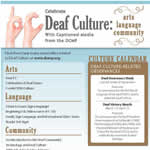
It’s an annual event with international appeal. The last full week (Sunday–Saturday) of September is Deaf Awareness Week, celebrated across the globe as Deaf World Week. Held to commemorate the first World Congress for the Deaf in 1951, Deaf Awareness Week is a celebration of the culture, heritage, and language unique to deaf people around the world.
As a longstanding advocate for the culturally Deaf, the DCMP has built into its free-loan media collection a varied assortment of titles detailing many aspects of Deaf culture, including Deaf arts, sign language, and Deaf communities. We also provide titles with insight into how technology—from the Internet to cochlear implants—is being integrated into an ever-evolving sense of Deaf culture. Kick off your school’s or organization’s celebration of Deaf Awareness Week with Deaf culture–themed media from the DCMP! For more on Deaf Awareness Week, including National Association of the Deaf’s new “A3” (ASL is Awesome for All!) page (coming very soon), visit the NAD Web site. CaptionMax Services Provide Universal Access to MediaBack to article listingThis article was contributed by Jay Wyant, Marketing Director for CaptionMax, DCMP’s partner in providing access to educational media through Emerging Technologies. Are you a sighted person? You may be interested in this experiment. Put a DVD of your favorite movie in your DVD player and grab your television remote control (we’ll give you that much as a head start, just to be fair). Now close your eyes. Do you know where the power button is? Good! Now, with your eyes closed, can you navigate the DVD’s menu? Suppose you wanted to see if it has description available. Can you find out without opening your eyes? Suppose you wanted to watch a particular scene in the program. Can you find that scene? By now, you have observed that this DVD, like most DVDs, is not very accessible to people with little or no eyesight. It doesn’t have to be that way. In fact, DVDs present a rich opportunity to expand the world of video. Not for nothing was the term “multimedia” coined to describe products delivered by DVD and computer; these delivery systems are capable of doing much more than the video programs you see on TV or at the movies. Multimedia doesn’t have to mean just more pictures and games. It can also mean more ways to deliver useful information to students, regardless of whether they have disabilities. That’s why we at CaptionMax developed the Universal Access to Media (UAM) program. We designed UAM to explore new and better ways to make media accessible. But we didn’t stop there. Just as curb cuts have proven to have value beyond enabling wheelchair users to cross streets, we felt that we could stretch and improve how captions and descriptions work in such a way that they could benefit a wide range of learners. |

EQUAL ACCESS: PROGRESSWe’re proud to announce a major step forward for DCMP’s streamed media: beginning immediately, all new streamed titles will be presented in Flash video format! By switching to the popular and widely-used Flash video format, the DCMP is able to provide higher quality and better performance on its streamed media (especially when viewing at full-screen size). Visit the announcement on the DCMP Web site to see a list of Flash-enabled titles. 
MARK YOUR CALENDARSThe DCMP/AFB Description Key is set to launch in early October 2008. While we polish the Key for its release, we invite you to take a look at an informational flyer overviewing the Description Key’s features [PDF].
FCTD: A VALUABLE RESOURCE FOR TEACHERS AND PARENTSThe Family Center on Technology and Disability (FCTD) plans to run a feature on DCMP in its October newsletter. According to its Web site, the FCTD is “a resource designed to support organizations and programs that work with families of children and youth with disabilities…[offering] a range of information and services on the subject of assistive technologies…[for] organizations, parents, educators, and interested friends…" Visit the FCTD at www.fctd.info.
SENATE PASSES ADA AMENDMENTS ACTOn September 11, 2008, the U.S. Senate unanimously passed S.3406, the ADA Amendments Act of 2008 (a very similar bill was previously passed by the House as H.R. 3195 on June 25, 2008). The ADA Amendments Act of 2008 is intended to “restore the intent and protections” of the ADA of 1990, while simultaneously overturning numerous court decisions that had essentially limited the ADA’s effectiveness in protecting Americans from discrimination in employment or accommodation.
|
|
The Described and Captioned Media Program is funded by the U.S. Department of Education and administered by the National Association of the Deaf. |
Visit the DCMP Web Site |
This newsletter is distributed to DCMP clients and other interested persons.
If you received this newsletter as an e-mail forward or found it on the Web, and you would like to sign up to receive the semi-monthly DCMP newsletter, please visit our sign up page on DCMP.org.